 HCI Nerdz
Human-Computer Interaction, User Interface, and User Experience think tank.
Shell and CLI standards live at our sibling org, openshellorg.
What we care about
We advocate for and invest in demonstrating discoverable surfaces that lower cognitive tax. Human-Computer Interaction (HCI) and User Interface/User Experience (UI/UX) design are foundational to how computers fit into our lives: software should respect our cognitive limits and attentional resources, lean on mental models people already have or teach better ones, and keep features and usage on the path of discoverability and least surprise.
- Discoverability People should find what the product can do without memorizing a priesthood.
- UIs that promote good habits When a convention fights how people already think, fix it — even if the industry is used to it.
- Search, don't sort Put search and filters above the list you are working in — not off to the side, and not behind a query language people have to learn.
- Respect user attention Tools should be minimally invasive. Heirloom software over dopamine products.
- Scoped UX Many narrowly scoped tools under one roof, used together for a workflow — each tool keeps a clear job.
- Transferable knowledge Reuse the same core patterns across tools so learning the first one makes the next cheaper.
Domains of HCI we work in
The repertoire is wide on purpose. Not every domain ships a flashy demo first — some start as diagrams and conventions.
- Navigation Edge maps, layered routes, step-by-step paths.
- Windowing & spatial UI Lite palettes, torn-off tools, multi-window desks.
- Settings & context Bound panes and scoped tools beside the work.
- Search & filters Discoverable filter literacy, not syntax-only doors.
- Information architecture Labels, types, identity, and sequence maps.
- Inbox & attention Glanceable canvases and agent task grids.
- Feedback & trust Provenance marks and severity that reads true.
- Theming & visual contracts Previews and chrome that inherit the host.
- Selection & dialogs Unified open/save and pickers — still on the roadmap.
Blog
Essays on HCI, UI, and UX — separate from org news.
- Persisting agent work as a node graph
Linear chat lies about parallel agent work. Persist a node graph on disk; spawn children when topic forks; parent and child record each other's address.
- Making model assumptions transparent
Assistant chat treats guesses and researched facts as the same confident prose. Trust needs provenance on the tokens themselves — so you can see what the model assumed before you pay for the mistake.
- Seeing parallel agents as a task grid
Twelve concurrent repo jobs should not serialize into one scroll. A task grid with status lights and fork chats shows parallel work as parallel.
Demos
Interactive experiments, grouped by familiar UI domains — navigation, windowing, settings, information architecture, and more.
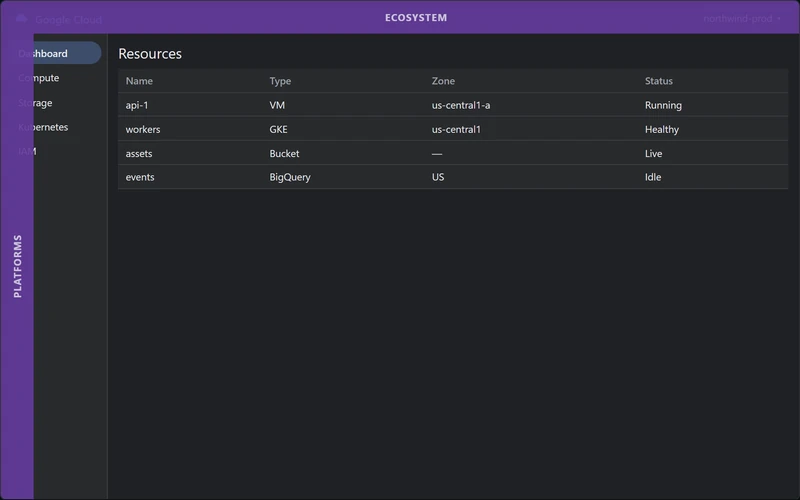
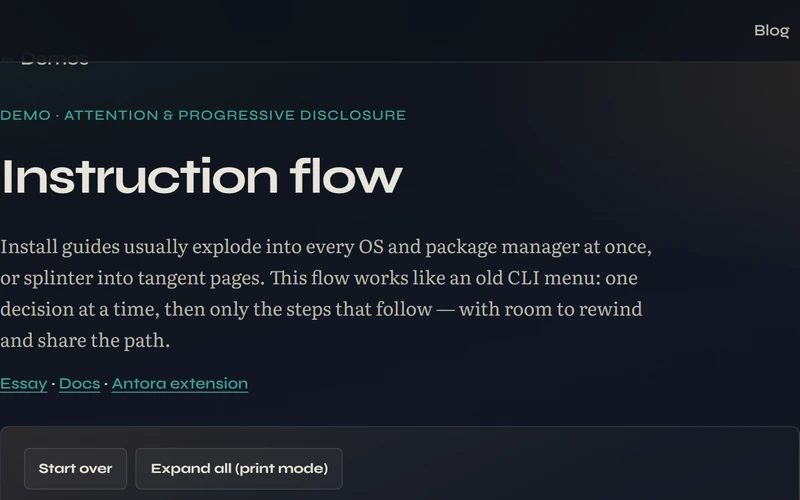 Instruction flowMenu-style install guides: choose a path, see only the next clear steps, rewind and share the URL. Continuations nest under decisions instead of dumping every platform variant at once.
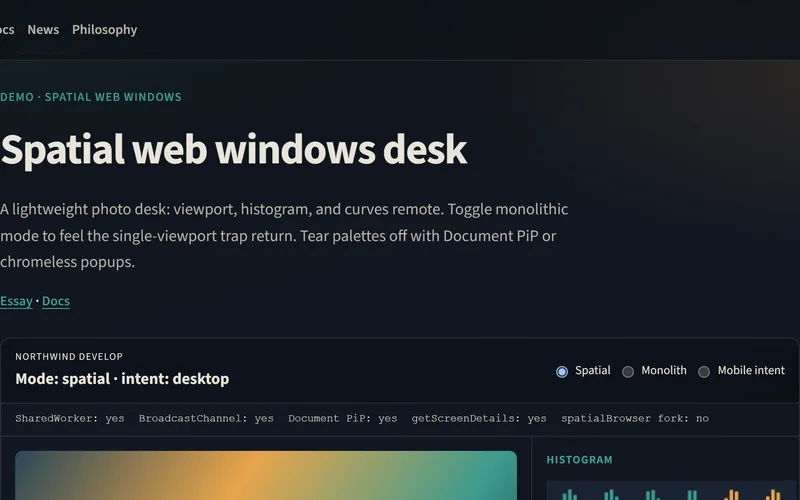 Spatial web windows deskPhoto-grade desk with torn-off histogram (Document PiP) and curves remote (chromeless popup). Toggle monolith vs spatial vs mobile intent.
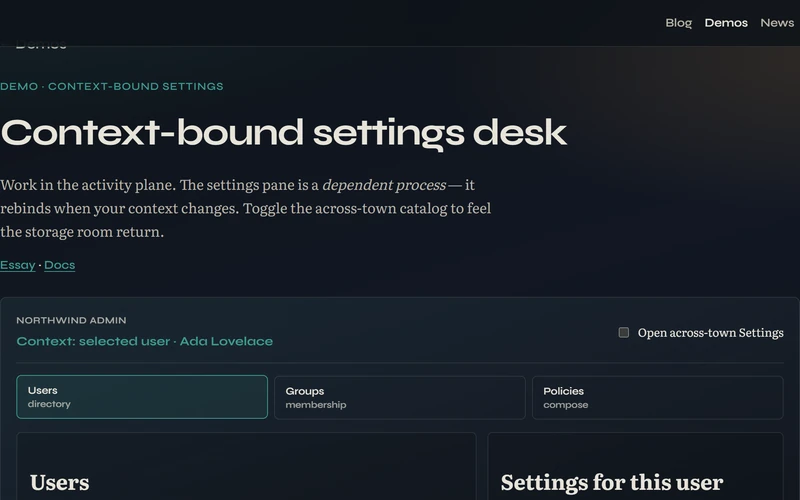 Context-bound settings deskActivity UI publishes context; a dependent settings pane matches applicability and shows only bound controls. Toggle the across-town catalog to feel the storage room return.
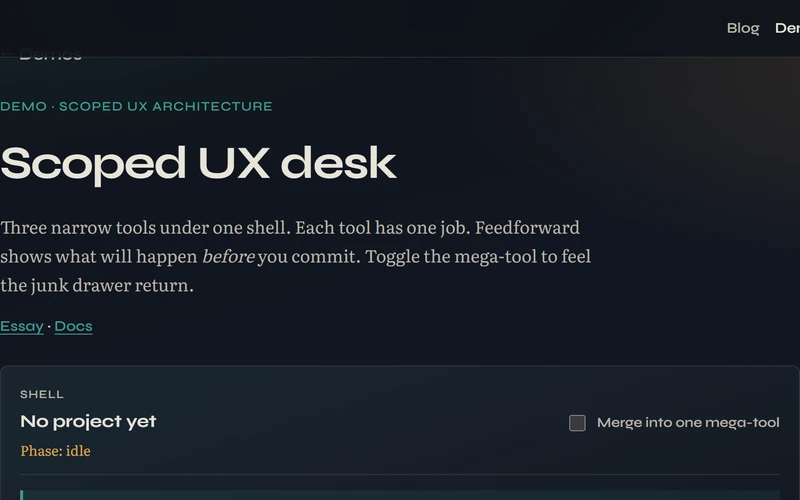 Scoped UX deskThree narrow tools (Projects, Environment, Remote) with feedforward previews. Toggle mega-tool mode to feel the junk drawer return.
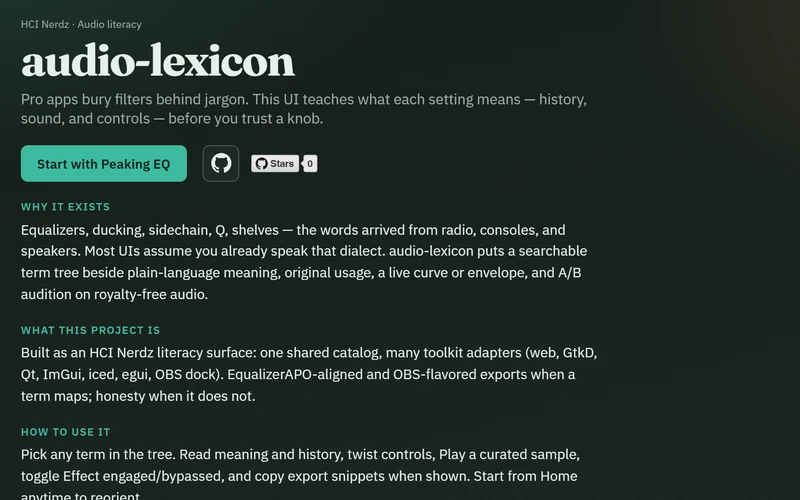 Audio lexiconPro-audio filter literacy: term tree, history, visualization, and A/B audition — then EqualizerAPO / OBS export when a term maps.
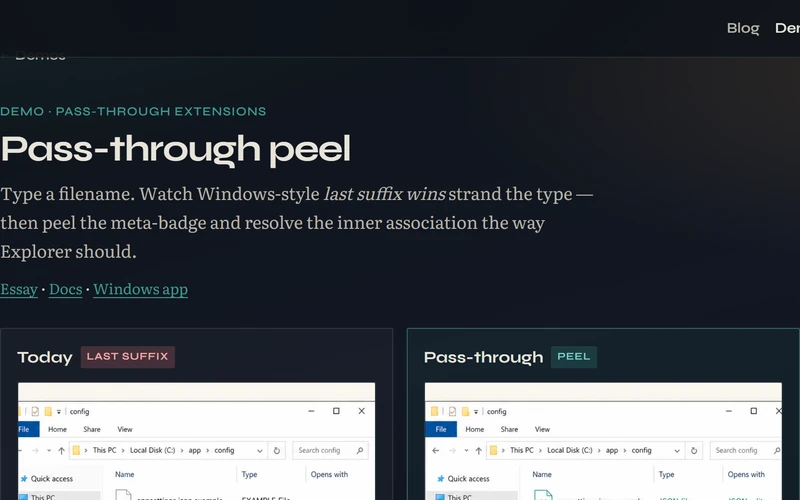 Pass-through peelMeta-suffixes like .example and .template are badges on a real type. Peel them and resolve open/icon from the stem — the way Explorer should.
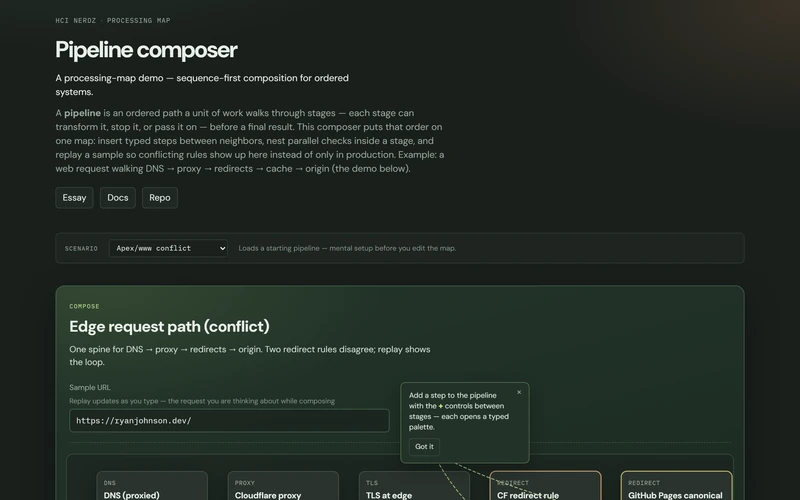 Pipeline composerTyped processing map for edge/request paths. Insert-between sockets, nested composites, and replay that surfaces apex/www redirect loops.
News
Org updates as HCI Nerdz takes shape — not essays.
- Actor-model agentic UI added to the repertoire
Persisted node graph for agent harnesses — typed actors, spawn-on-drift, disk addresses, task grid view — with essay, docs, demo, and DevCentr ACTOR_AGENTIC_UI variables.
- Grounded tokens added to the repertoire
Visual provenance for AI assistant output - heuristic dashed warm underlines, researched solid cool underlines - with essay, docs, and an interactive fork-name desk.