Context-bound settings
Context-bound settings are configuration controls presented on a surface beside the activity UI, filtered by the activity’s live context (view, selection, mode, draft), so the user does not leave the here-and-now to rebuild mental models in a distant Settings tree.
In plain language: settings follow the work as a dependent process — not a storage room across town.
Core claim
Most products treat Settings as a destination: leave the task, open a catalog, hunt a control, save, walk back. That forces the user to recreate the mental context the activity already had.
Preferred shape:
-
Activity UI remains primary — browsing users, editing a group, composing a policy stay in the main plane
-
Settings surface is dependent — a sidebar / inspector / docked pane that subscribes to activity context
-
Applicability predicates — each setting declares when it is relevant; the pane renders only matches
-
Global catalog remains — full search, audit, and power-user jumps still exist; default altitude is context-bound
Why it exists
Admin consoles and multi-state web apps bury consequence. A toggle labeled "External members" means something when you can see the Engineering group; it means almost nothing on page 40 of Organization → Advanced.
Desktop inspectors and property sheets approximate the pattern for selected objects. Cloud consoles rarely do for activity states. The gap is product representation: the engine already knows which object and mode are live; the Settings gear pretends otherwise.
Mockups
Anti-pattern — settings across town
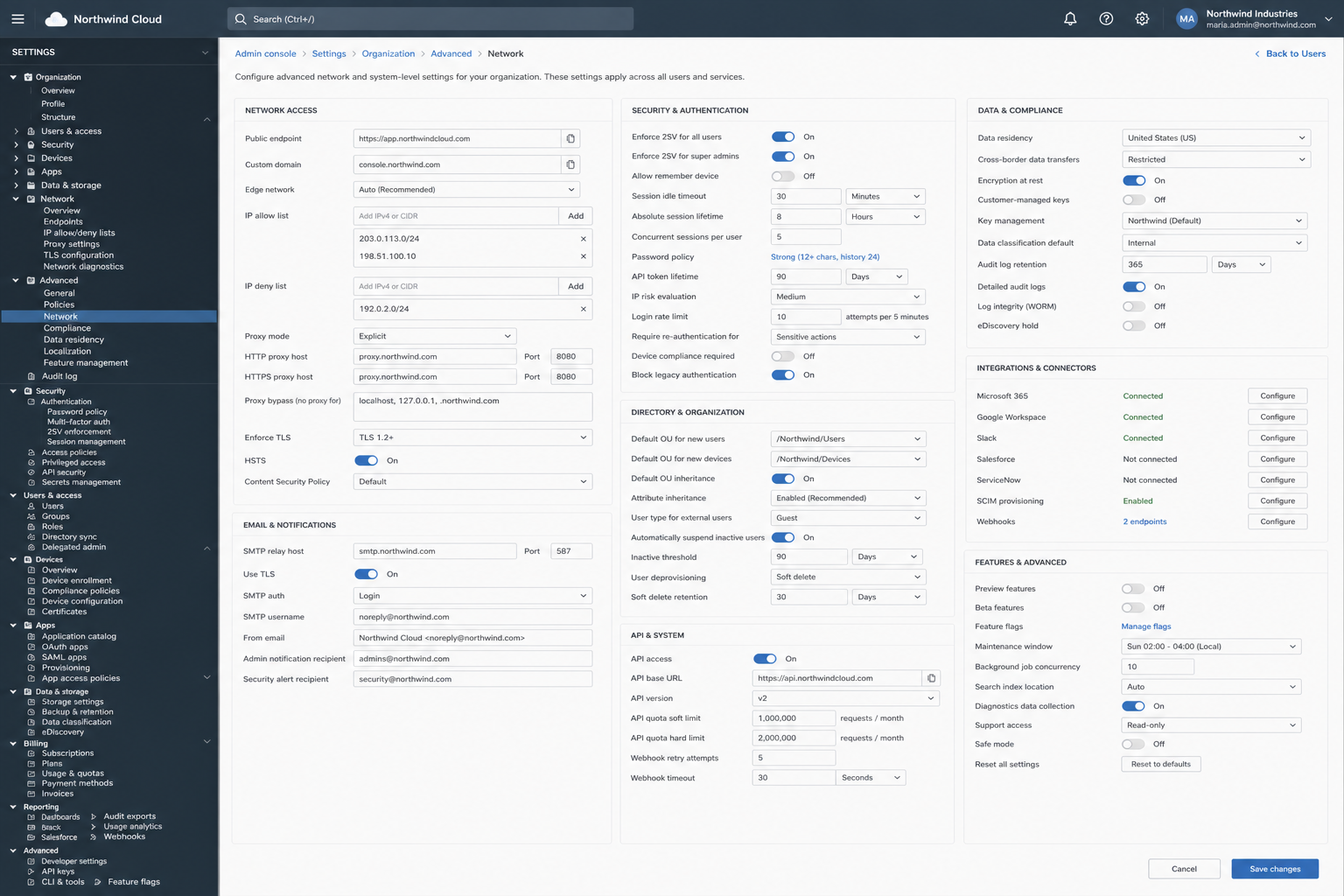
Deep breadcrumbs, unrelated columns, Save as a single decision over many domains. The user who was managing a person now holds that person in working memory while editing SMTP and API quotas.
Bound to a selected user
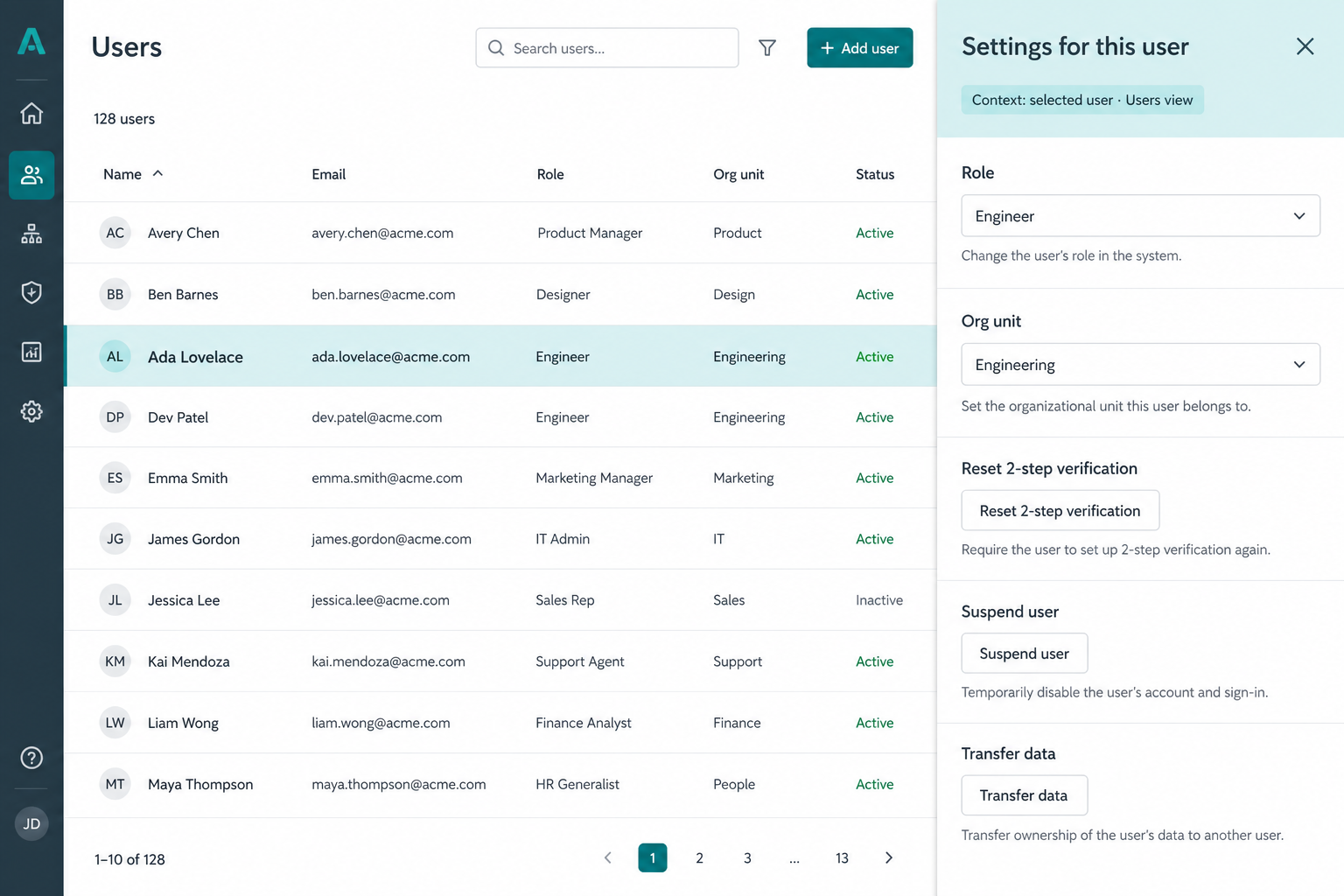
Activity stays visible.
The pane names the bind (Context: selected user · Users view) and lists only user-applicable controls with plain consequences.
Same shell, group activity state
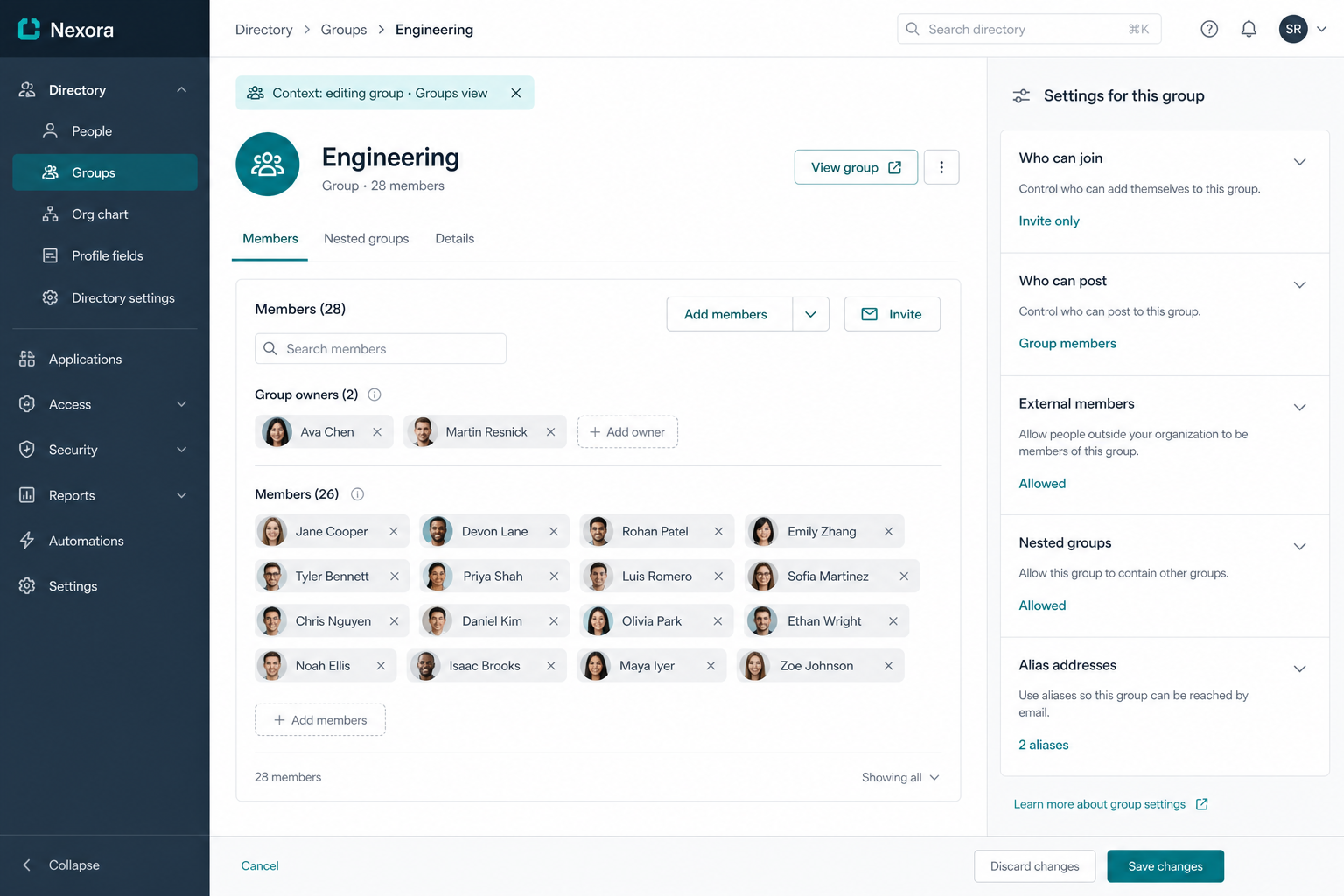
Meaningful context transition → pane reshapes. Membership work and group policy sit in one field of view.
Architecture
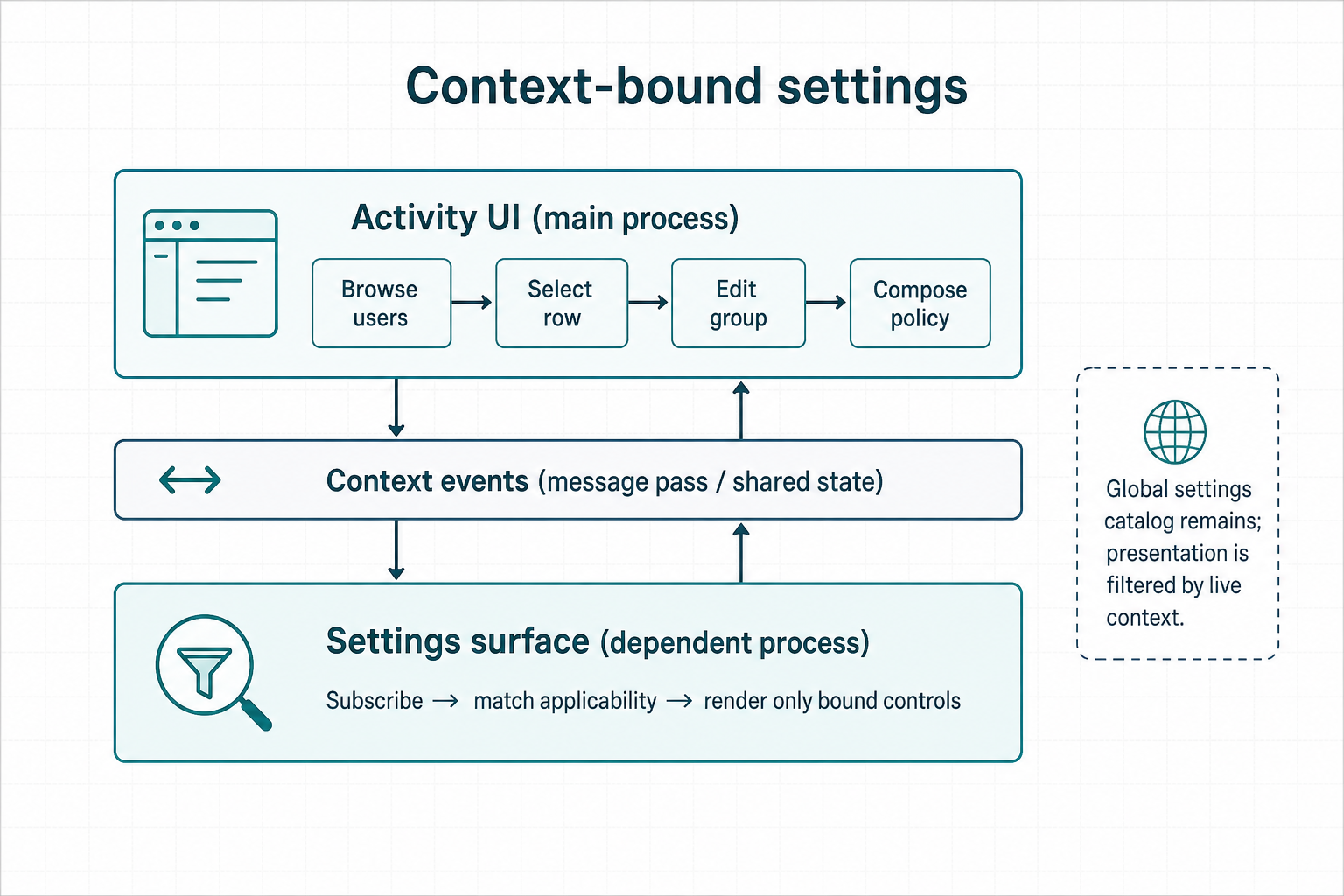
| Layer | Job |
|---|---|
Activity UI (main process) |
Owns views, selection, modes; emits context events |
Context bus |
Message pass, reactive store, or IPC / shared memory across process boundaries |
Settings surface (dependent process) |
Subscribe → match applicability → render bound controls; write back to the catalog |
Global catalog |
Authoritative inventory; filtered for presentation, not deleted |
Applicability model (sketch)
Treat each setting as a record with at least:
-
id— stable catalog key -
appliesWhen— predicate over context (view,selectionType,mode,capabilities, …) -
render— control + short consequence copy -
source— where the value lives (API, policy file, directory attribute)
Example contexts:
-
{ view: "users", selection: { type: "user", id } }→ role, OU, 2SV reset, suspend, transfer -
{ view: "groups", mode: "edit", selection: { type: "group", id } }→ join policy, posting, external members, aliases -
{ view: "policies", mode: "compose", draftId }→ scope, enforcement, exceptions for this draft
Reshape the pane on meaningful transitions (view change, selection change, mode change) — not on every keystroke — so spatial memory inside the pane can form.
Implementation notes
In-process web / desktop
A shared store (signals, Redux, Elm architecture, SwiftUI environment, Qt property bindings) is enough when activity and settings share a process. The settings module must not own the context; it observes it.
Cross-process shells
When the activity lives in one process and chrome / settings in another (browser extension side panels, IDE plugin hosts, multi-window desktop), use explicit message passing or shared memory with a versioned context schema. Stale context is a correctness bug: show a disconnected state rather than editing the wrong object.
Catalog escape hatch
Always offer Browse all settings / jump-to-catalog for the current key. Context-bound is the default altitude, not a prison.
Honesty
Pair with GUI / source-of-truth sync from Principles: the pane reflects real config; jump to policy JSON / directory source when the file is authority. Pair with feedforward where outcomes are predictable (Scoped UX architecture).
Non-goals
-
Deleting the global Settings catalog
-
Magical rearrangement that hides causality (always name the bind)
-
Replacing object inspectors — this generalizes them to activity states
-
Auto-mutating the activity chrome based on ML guesses of intent (different problem class)
Prior art / related
-
Windows property sheets — About Property Sheets
-
Design-tool properties panels (selection-bound inspectors)
-
Context-aware UIs — Context-Aware Computing (IxDF)
-
Adaptive UI / Event–Condition–Action literature
-
Lucy Suchman — Plans and Situated Actions (situated meaning; design-time critique we push toward runtime bind)
-
Henry Lieberman & Ted Selker — Out of context: Computer systems that adapt to, and learn from, context
-
Ben Shneiderman — direct manipulation (visibility of the object of interest)
Prototype
-
Blog essay: When settings live across town
Literature
-
Prompt seed — context-bound settings (2026-08-10) — originating framing for the dependent-process claim
Related
-
Principles — progressive disclosure; GUI / source-of-truth sync
-
Scoped UX architecture — narrow tools make applicability honest
-
Philosophy — product representation; attention ethics