 HCI Nerdz
When config files withhold the vocabulary
A settings UI is not chrome on a text file. It is the shared list of legal fields — including the ones the author never wrote. Generic config panels exist in fragments; the missing product treats schema minus instance as the default altitude.
Ada opens terraform.tfvars. Two keys: region and environment. The rest of the module’s inputs — the ones reused across every stack she has ever copied — live in variables.tf, in the provider schema, in last quarter’s example that someone deleted. The file is honest about what she saved. It is silent about what she is allowed to save.
That silence is not a personality trait of Terraform. It is the natural state of INI, YAML, TOML, SDLang, cfg, JSON. Syntax is not vocabulary. A form needs the second document: types, enums, defaults, a one-line why. Without it, a generic “config GUI” can only replay the two keys she already knew.
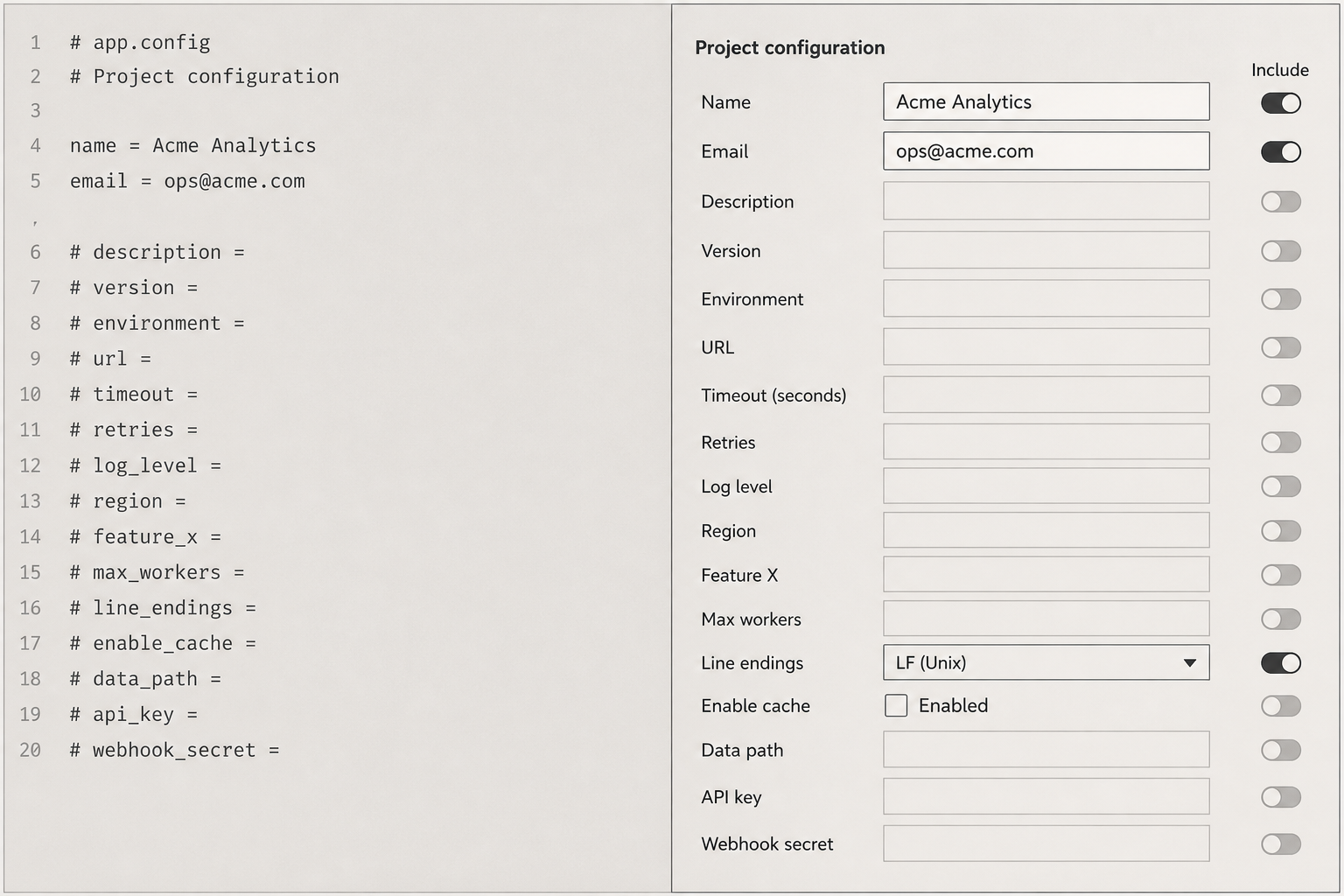
Settings as a shared field list
When settings live across town is about where a settings surface sits relative to work. This is the cousin problem: what the surface is allowed to name when the artifact is a file some other team authored.
GNOME already answers it for apps that opt in. Ship a .gschema.xml; dconf-editor renders keys the application never wrote to disk. KDE’s KConfigXT is the same contract in XML. Windows ADMX templates generate Policy UI from a catalog. Developers get SchemaStore plus hover text inside the editor — discovery as autocomplete, not as a Control Panel.
None of those products will open Ada’s tfvars and her .gitconfig and a dub.sdl with the same widgets, then remember the path after she touches it. Elektra tried the hierarchical mount. Augeas tried /files/etc. Schema-to-form toys (JSON Schema form builders) try the on-the-fly slice. The durable design is all three: storage plugins, a schema catalog, one panel.
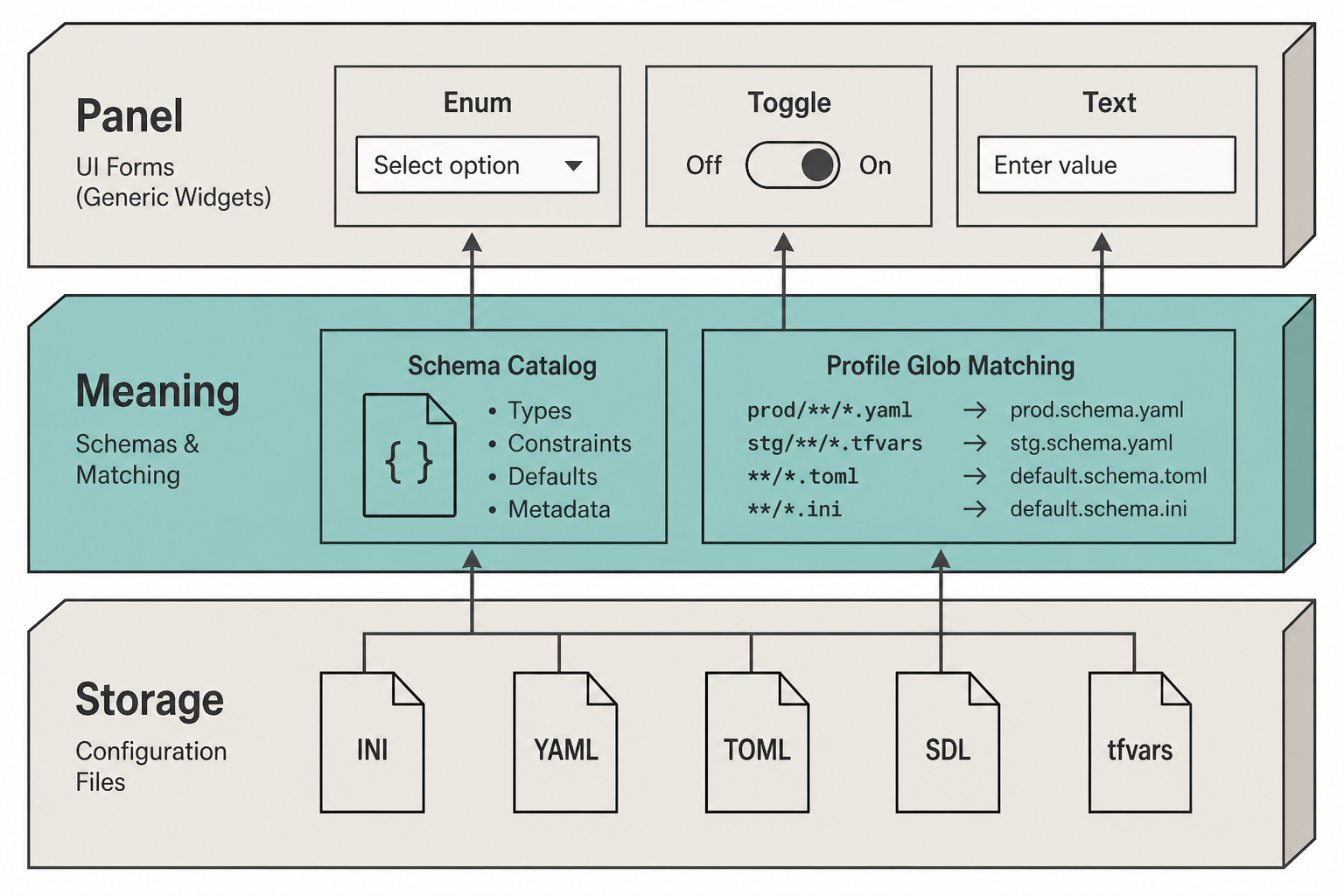
Schema minus instance
The useful default altitude is not the raw buffer. It is the schema minus the instance — unset optional fields sitting there in muted type, with an include toggle, so Ada can discover user.email the same way dconf-editor shows keys GNOME apps left at default.
Arbitrary maps (tags = { anything: anything }) remain hostile. HCL programs are not settings documents. Those need domain adapters; they should not poison the INI path. SDLang is a decent profile carrier because metadata does not have to hide in a comment convention JSON never grew.
Dev-Centr is shipping that stack as UniConfig Config Panel: a D library for the tree, a dlangui desktop for the panel, SDLang profiles for globs. The HCI claim does not depend on the toolkit. It depends on treating field vocabulary as a first-class UI, not as something the last author happened to type.
Docs: UniConfig. Record: Config files get a Control Panel.